
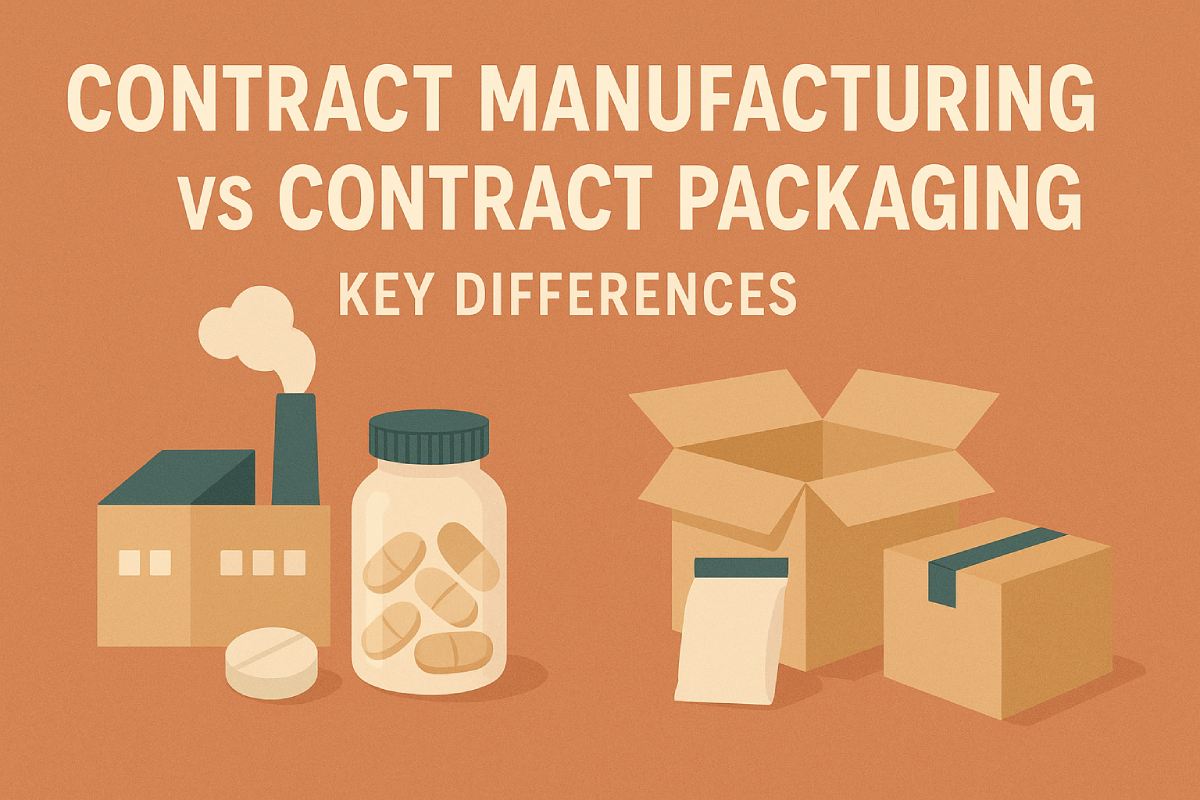
In the supplement world, bringing a product to life involves two major players: contract manufacturers and contract packagers. While their roles are closely related, they serve very different functions in turning a concept into a market-ready product.
Understanding the difference between these two is crucial for brands that want to launch efficiently, maintain quality, and maximize profitability. Whether you’re a new wellness brand or an established supplement company expanding your product line, knowing who does what can save you time, money, and major headaches down the line.
What Is Contract Manufacturing?
Contract manufacturing (often abbreviated as CMO) refers to the process where a brand partners with an external facility to produce the actual product — from formulation to blending, encapsulation, or filling. In short, contract manufacturers make your supplements.
They handle every stage of production, including:
- Product formulation and development
- Ingredient sourcing and testing
- Mixing, blending, or encapsulating
- Flavoring and texture optimization
- Batch testing and stability checks
A contract manufacturer transforms your concept into a tangible product that meets your specifications and complies with all safety and labeling standards.
Benefits of Contract Manufacturing
- Expertise and Efficiency
Manufacturers specialize in supplement production. They already have the equipment, staff, and systems in place to make your formula efficiently and consistently.
2. Cost Savings
By outsourcing production, brands avoid the high upfront investment in equipment, facilities, and labor. You pay only for the services you need, when you need them.
3. Customization
Manufacturers can create unique formulations, adjust flavor profiles, and scale production to meet demand — helping your product stand out in a crowded market.
4. Focus on Growth
With manufacturing handled, you can focus on marketing, branding, and distribution — the elements that drive your business forward.
What Is Contract Packaging?
Contract packaging (also called copacking) comes into play after manufacturing. While the manufacturer makes the product, the packager prepares it for sale.
This includes:
- Filling bottles, jars, or sachets
- Applying labels and safety seals
- Shrink wrapping and boxing
- Assembling display kits or multipacks
- Managing inventory and logistics
Simply put, contract manufacturers create your supplements, while contract packagers get them shelf-ready and market-ready.
Benefits of Contract Packaging
- Professional Presentation
Packaging plays a huge role in consumer perception. Contract packagers specialize in precise, consistent, and visually appealing packaging that enhances your brand image.
2. Flexibility in Formats
They can work with various packaging types — bottles, pouches, blister packs, stick packs, or cartons — helping brands adapt to retail or e-commerce needs.
3. Streamlined Supply Chain
Experienced packagers can handle storage, labeling, and distribution, allowing for faster turnaround times and smoother logistics.
4. Quality and Compliance
Packaging must meet safety and labeling requirements, especially for supplements. A professional packager ensures that every container is filled, sealed, and labeled correctly.
The Relationship Between Manufacturing and Packaging
While these functions are separate, they often overlap. Some facilities offer both manufacturing and packaging under one roof, while others specialize in one service.
For example:
- A manufacturer may produce the capsules and send them to a separate packager for bottling.
- A full-service partner may handle everything from raw material sourcing to labeling and shipping.
Understanding this relationship helps brands choose the most efficient workflow for their goals and budget.
Key Differences Between Contract Manufacturing and Contract Packaging
| Aspect | Contract Manufacturing | Contract Packaging |
| Primary Function | Produces the supplement | Packages and prepares product for sale |
| Process Involves | Formulation, mixing, testing | Bottling, labeling, sealing |
| Goal | Create the product | Present and protect the product |
| Timing in Production | Early-to-mid process | Final stage before shipment |
| Expertise | Ingredient science, formulation | Packaging design, logistics |
When to Use a Contract Manufacturer
If you’re developing a new supplement, adjusting an existing formula, or scaling production, a contract manufacturer is your starting point. They help with R&D, formulation, and the technical side of creating a market-ready formula.
Use contract manufacturing when:
- You need custom formulations or flavor development.
- You’re launching a new product line or increasing volume.
- You want help sourcing high-quality ingredients.
Manufacturers focus on what’s inside the bottle — the formula, quality, and performance of your supplement.
When to Use a Contract Packager
If your product is already manufactured and you need it to look retail-ready, a contract packager is your go-to partner.
Use contract packaging when:
- You have a bulk product that needs bottling or labeling.
- You’re entering retail distribution and require UPC codes, tamper seals, and branded designs.
- You need custom packaging formats like pouches, blister cards, or sample packs.
Packagers focus on what’s outside the bottle — presentation, protection, and compliance.
The Advantage of Working with a Full-Service Partner
While it’s possible to work with separate companies for manufacturing and packaging, many brands prefer an all-in-one solution that handles both.
The benefits include:
- Simplified communication — one partner manages everything.
- Faster lead times — no delays between production and packaging.
- Lower logistics costs — no need to transport product between facilities.
- Stronger brand consistency — seamless transition from product to packaging.
For growing supplement brands, this integrated approach is often the most efficient path from concept to shelf.
What to Look for in a Manufacturing or Packaging Partner
- Experience in supplements – Choose a partner who understands ingredients, flavor systems, and regulatory requirements.
- Scalability – Ensure they can handle both small pilot runs and large retail production.
- Transparency – Ask about sourcing, process timelines, and quality control.
- Design support – For packagers, ensure they can assist with branding, labeling, and visual layout.
- Communication – A responsive, collaborative partner is key to hitting deadlines and maintaining consistency.
Final Thoughts: Choosing the Right Partner for Your Brand
Both contract manufacturing and contract packaging are essential parts of supplement success — they just serve different roles. Manufacturers bring your formula to life, while packagers make it ready for the world to see.
For most brands, working with an experienced, full-service partner is the best route — simplifying the process while maintaining control over quality and timelines. The key is to know what each partner brings to the table and align that expertise with your business goals.
Partner with Enhanced Labs
At Enhanced Labs, we provide end-to-end supplement solutions, from product development and ingredient sourcing to packaging, labeling, and fulfillment.
Whether you’re creating a new formula or rebranding an existing line, our team helps streamline every stage of production so your products look, feel, and perform at the highest level.
We offer complete customization across capsules, powders, gummies, and drinks, plus in-house packaging options for bottles, pouches, and stick packs.
Let’s bring your supplement vision to life — from formula to finished product, all under one roof.